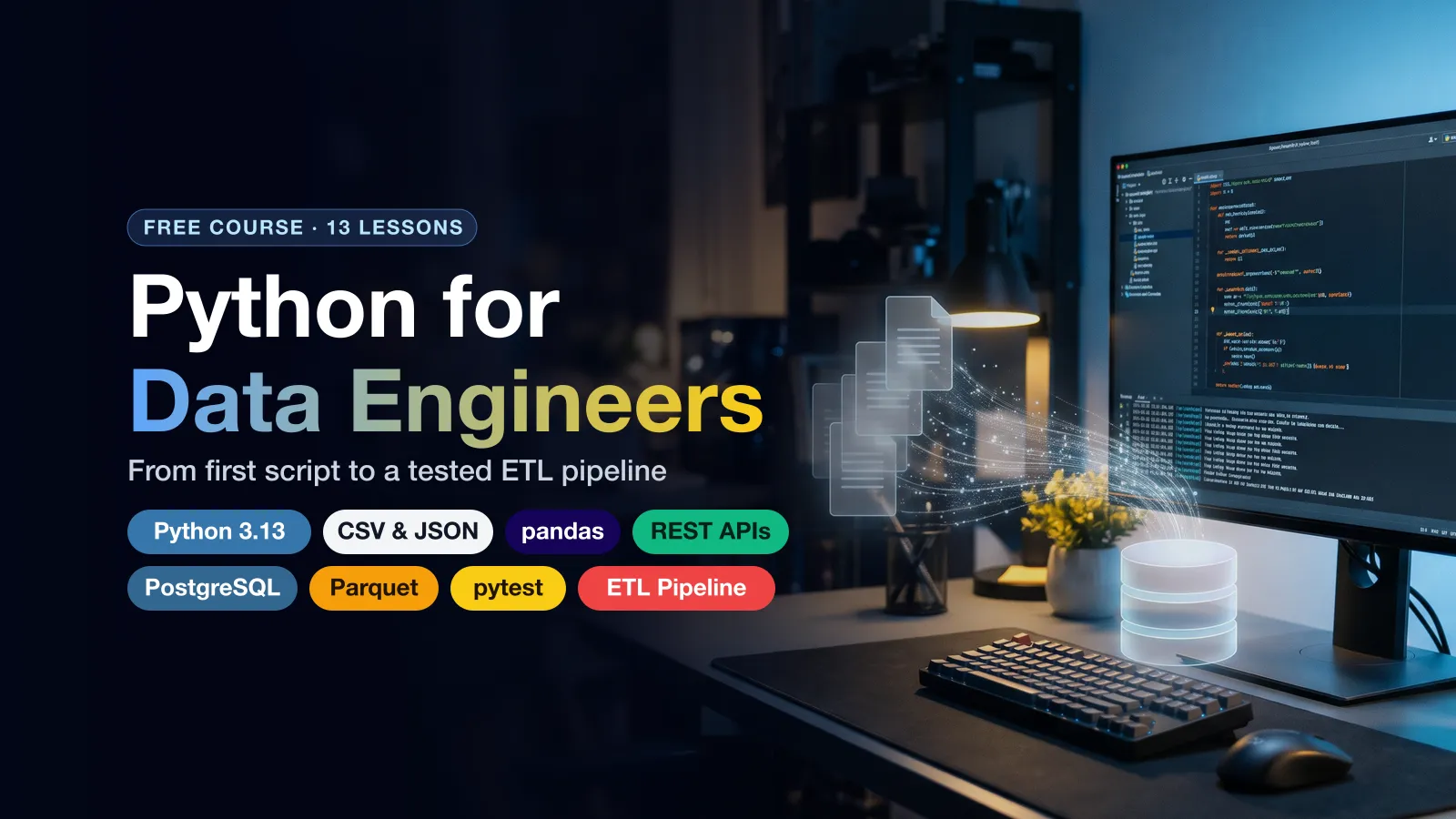
Free course · 13 lessons · first 2 open, free sign-in for the rest
Learn Python the way data engineers use it
From your first script to a tested pipeline that loads a database. Every example shows the real output it printed, and every lesson ends with what to memorize and interview questions.
- Variables, strings, lists, dicts and comprehensions
- Functions, modules and clean code
- CSV, JSON, JSON Lines and big files
- Errors, validation, logging and retries
- REST APIs (with async), pandas, Parquet and PostgreSQL
- A tested ETL project and 50 interview questions
Why it works
Built so it actually sticks
One messy dataset
ShopKart's order files have duplicates, blanks and typos on purpose, so you learn to handle real data.
Real output
We ran every example on Python 3.13. The output under each code block is exactly what it printed.
A real project
You finish with an ETL pipeline that has tests, logging and an idempotent load into PostgreSQL.
The roadmap
Follow the trail, one part at a time
Each part builds on the one before. Your progress is saved in this browser, so you can pick up where you left off.
0 of 13 parts completed
Start the course- 1Part 1·8 minFree previewStart here
Python for Data Engineers
Why data engineers use Python and how to start: installing Python, virtual environments, running scripts, and your first data script, explained simply.
- 2Part 2·10 minFree preview
Python Basics
Python's building blocks for data work: numbers, text, booleans, None, f-strings, string cleaning, type conversion and why money needs Decimal, with real output.
- 3Part 3·12 min Enroll to unlock
Python Lists, Dicts, Sets and Comprehensions
Work with records like a data engineer: lists, tuples, dictionaries, sets, comprehensions, sorting with key, and grouping with defaultdict and Counter.
- 4Part 4·11 min Enroll to unlock
Python Functions, Loops and Modules Explained
If, for, while, enumerate and zip; functions with type hints, defaults, *args and **kwargs; the mutable default trap; lambdas; and splitting code into modules.
- 5Part 5·12 min Enroll to unlock
Python Files, CSV and JSON for Data Engineers
Read and write files the right way: pathlib, with, csv.DictReader, JSON and JSON Lines, flattening nested JSON, and generators for files bigger than memory.
- 6Part 6·11 min Enroll to unlock
Python Errors, Validation and Logging
Make pipelines robust: try/except/else/finally, validating rows and keeping rejects, custom exceptions, the logging module, and retries with exponential backoff.
- 7Part 7·12 min Enroll to unlock
Python APIs with requests
Pull data from REST APIs with requests: status codes, auth tokens from env vars, timeouts, pagination, automatic retries, and saving raw responses as JSON Lines.
- 8Part 8·14 min Enroll to unlock
Pandas for Data Engineers
Pandas for real pipelines: read CSV and JSON, find and fix messy data, filter, group, merge, handle dates, write Parquet, and process big files in chunks.
- 9Part 9·12 min Enroll to unlock
Python and PostgreSQL
Talk to databases from Python: connect with psycopg, parameterised queries (and why f-strings break), transactions, upserts, bulk loading with COPY, and SQLite.
- 10Part 10·13 min Enroll to unlock
Python Generators, Decorators and Dataclasses
The advanced Python interviewers ask: iterators and generator pipelines, decorators, context managers, dataclasses, classes, copies, and threads for faster I/O.
- 11Part 11·13 min Enroll to unlock
Async Python
Speed up API-heavy Python with asyncio and httpx: gather, Semaphore limits, error handling, retries and async vs threads. Real timings: 6.3 s down to 0.4 s.
- 12Part 12·15 min Enroll to unlock
Build a Python ETL Pipeline
Build a real ETL pipeline in Python: project structure, config from env vars, extract, transform, idempotent load to PostgreSQL, logging, argparse and pytest.
- 13Part 13·15 min Enroll to unlock
Python Interview Questions for Data Engineers
50 Python interview questions for data engineers: 15 coding problems solved and run, plus concepts like the GIL, generators, decorators, copies and pandas.
- 14Polars: the fast DataFrame libraryComing soon
- 15Packaging and Docker for pipelinesComing soon
Who it's for
Made for you if…
Complete beginners
You've never programmed and want to start with data in mind.
SQL people
You know SQL and need Python for APIs, files and automation.
Interview prep
You want generators, decorators, pandas and coding problems to feel easy.
FAQ
Questions students ask
Is this Python course free?
Yes, completely free. The first two lessons are open to everyone; sign in with Google, GitHub or email and enroll (also free) to read the rest. Enrolling also saves your progress across devices.
Do I need programming experience?
No. Lesson 1 starts from installing Python. Knowing a little SQL helps for lesson 9, and our SQL course covers it.
Which libraries does it use?
Mostly Python's standard library (csv, json, pathlib, logging), plus requests for APIs, pandas and pyarrow for DataFrames and Parquet, psycopg for PostgreSQL, and pytest for tests.
Is Python or SQL more important for data engineering?
Both. SQL transforms data inside databases and warehouses; Python moves data between systems, calls APIs, automates and tests. Most jobs ask for both.
How is this different from a general Python course?
Every example is a data engineering task: cleaning order files, flattening JSON, paginating APIs, loading databases, making pipelines idempotent and testable.
Start with Lesson 1: Why Python for data engineering?
About 2 hours 38 minutes for the whole course. Your progress is saved in this browser as you go.